
AiCROV Twin LSG Semi-Automatic Jerrycan Filling System
The AiCROV Twin LSG is a semi-automatic liquid filling arrangement designed for manufacturers requiring greater production flexibility and output when filling jerrycans and other suitable small industrial containers.
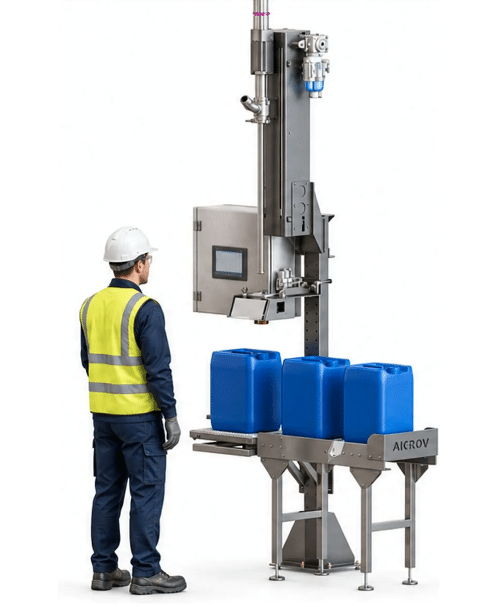
Semi-Automatic Filling for Jerrycans and Small Containers
Combining two AiCROV LSG filling machines within a coordinated production layout, the system allows one operator to manage two filling stations while keeping different products separated.
A UK installation for a distillery demonstrates how this approach can improve the efficiency of jerrycan filling without requiring a fully automatic production line.
The installation incorporates two LSG filling machines, customised roller conveyors, a flushing system and semi-automatic capping equipment. It is configured for filling alcoholic products and was supplied with ATEX certification appropriate to the project.
E&B works with AiCROV to help UK manufacturers select suitable liquid filling equipment, taking account of product characteristics, container formats, production output and the operating environment.
Manufacturers filling liquids into jerrycans often need to balance production efficiency with flexibility.
Different products may require separate filling arrangements, particularly where cross-contamination between formulations must be avoided.
Container sizes may also change between production runs, while operators need to manage filling, closure application and movement of containers through the production area.
The AiCROV LSG is a semi-automatic weigh-filling machine designed for suitable jerrycans, canisters and pails from 1 to 30 litres.
In a twin configuration, two machines can be arranged alongside a shared conveyor system, allowing an operator to work across both filling stations.
This approach can increase output while maintaining the practical flexibility of semi-automatic machinery.
Key Features of the AiCROV Twin LSG
Two Semi-Automatic Filling Stations
The system uses two AiCROV LSG machines, allowing filling operations to be carried out at separate stations within the same production area.
One Operator Managing Both Machines
The UK installation was designed so that one operator could attend to both filling stations. This allows productive use of the time while one machine is carrying out its filling cycle.
Separate Product Filling
The two filling stations can be used to handle different products independently, helping avoid cross-contamination between the filling operations.
Customised Roller Conveyors
The installation incorporates free-running roller conveyors designed around the jerrycan formats and production layout.
Side Guides for Container Handling
Customised conveyor side guides help maintain the appropriate container position as jerrycans move through the filling area.
Integrated Flushing System
A flushing arrangement was incorporated into the installation to support the required cleaning and product-handling procedures.
Shared Electrical Cabinet
Both filling machines were configured with a common electrical cabinet as part of the overall installation.
Semi-Automatic Capping Equipment
A specially configured semi-automatic capping tool supports closure application after filling.
ATEX-Certified Project Configuration
The UK distillery installation was supplied with ATEX certification, reflecting the requirements of the products and operating environment. Hazardous-area suitability must be assessed individually for each proposed installation.
How Does the Twin LSG Filling System Work?
The Twin LSG combines semi-automatic filling with a coordinated container-handling arrangement.
A typical operating sequence involves:
Container infeed
Empty jerrycans are introduced onto the roller conveyor.
Container positioning
The operator places a jerrycan at the appropriate filling station.
Filling cycle
The selected LSG machine fills the container according to the required product and target quantity.
Parallel operation
While one filling station is operating, the operator can attend to the second machine.
Container discharge
Filled jerrycans are moved along the roller conveyor.
Semi-automatic capping
The operator uses the specified capping tool to apply the appropriate closure.
Downstream handling
Finished containers can proceed to labelling, packing or distribution.
The precise operating sequence depends on the equipment layout and the requirements of the manufacturer.
Proven UK Installation – Twin LSG System for a Distillery
AiCROV installed a twin LSG filling arrangement for a UK distillery producing alcoholic products.
The project demonstrates how two relatively compact filling machines can be combined to increase output while maintaining separation between different products.
The Production Requirement
The distillery needed a practical filling solution for jerrycans that could accommodate its production requirements without introducing unnecessary complexity.
Important considerations included:
- Filling alcoholic products into jerrycans
- Increasing production capacity
- Allowing one operator to manage the filling process
- Keeping different products separate
- Providing suitable container conveying
- Incorporating capping equipment
- Meeting the project's hazardous-area requirements
The AiCROV Solution
AiCROV installed two LSG semi-automatic filling machines joined by a customised free-running roller conveyor system.
The arrangement incorporated:
- Two independent LSG filling stations
- Roller conveyors adapted to the production layout
- Conveyor side guides
- A flushing system
- A shared electrical cabinet
- A specialised semi-automatic capping tool
- An ATEX-certified project configuration
The machines were positioned so that a single operator could work between them.
Benefits of the Installation
140
jerrycans per hour
Reported UK installation output
Using two LSG filling machines in the project configuration
This is the output reported by AiCROV for the specific UK installation. Actual production rates will depend on the product, container size, operator workflow and equipment configuration.
Benefits of the Installation
Improved production capacity
Two filling machines allow the operator to manage overlapping filling cycles, increasing the potential output from the production area.
Better use of operator time
The arrangement allows one person to attend to both machines rather than requiring a dedicated operator for each filling station.
Product separation
Independent filling stations help avoid cross-contamination between different products.
Practical container handling
Customised roller conveyors and side guides support the movement of jerrycans through the filling area.
Integrated closure handling
The semi-automatic capping tool allows closure application to be incorporated into the production workflow.
Application-specific safety
The installation was configured to meet the relevant ATEX requirements.
The project demonstrates how a relatively straightforward equipment arrangement can improve production efficiency without moving immediately to a fully automatic filling line.
Why Use Two Filling Machines Instead of One?
For some manufacturers, a single semi-automatic filling machine provides sufficient production capacity.
However, where output needs to increase, the filling cycle itself may create periods when an operator is waiting for the machine to complete its work.
A twin-machine arrangement allows the operator to use that time more productively.
While one machine is filling, the operator can prepare or handle containers at the second station.
The approach may also be valuable where different products need to be filled separately.
Rather than repeatedly changing one machine between formulations, two dedicated filling stations can provide a more practical arrangement.
The appropriate configuration depends on production volumes, product compatibility, available space and the level of automation required.
Avoiding Cross-Contamination Between Liquid Products
Cross-contamination is an important consideration for manufacturers handling different liquid formulations.
Even small amounts of residual product can affect the quality or specification of the next batch.
In the UK distillery installation, AiCROV used two separate LSG filling machines to allow different products to be handled independently.
This reduces the need to use the same filling path for every product.
A flushing system was also included as part of the installation.
For manufacturers evaluating a similar arrangement, the required cleaning and product-separation procedures should be established during the equipment specification process.
Separate filling stations can help reduce cross-contamination risks, but the complete process must still be assessed, including product supply connections, cleaning arrangements and operator procedures.
Jerrycan Filling for Alcoholic and Flammable Liquids
The UK installation was designed for a distillery filling alcoholic products into jerrycans.
Depending on the formulation, alcohol-containing liquids can create flammable vapours and require particular consideration of ignition risks.
The machinery and surrounding production environment must therefore be assessed against the relevant hazardous-area requirements.
AiCROV supplied the featured installation with ATEX certification.
This demonstrates the importance of specifying the equipment around the actual product and operating conditions rather than assuming that a standard filling machine is suitable.
E&B can work with AiCROV to assess the appropriate filling configuration and the requirements for suitably certified equipment.
AiCROV LSG Filling Technology
The underlying AiCROV LSG is a semi-automatic filling machine designed for jerrycans, canisters and pails.
It uses weight-based filling technology to dispense a controlled quantity of product into each container.
The LSG is designed as a relatively straightforward filling solution that can be introduced without the complexity of a fully automated line.
Its suitability for different products and container formats depends on the selected filling components, product-contact materials and application requirements.
Filling by Weight
Weight-based filling measures the quantity of product dispensed into the container. This can be useful where manufacturers require consistent net contents across production runs.
Container Flexibility
The LSG range is designed for suitable small containers between 1 and 30 litres. Different container shapes and openings may require specific positioning or filling arrangements.
Semi-Automatic Operation
The operator remains involved in presenting and handling containers, while the machine controls the filling cycle.
Configurable Accessories
Conveyors, capping equipment, flushing arrangements and other accessories can be incorporated according to the production requirement.
Twin LSG Technical Specifications
| Specification | AiCROV Twin LSG |
|---|---|
| Underlying machine | AiCROV LSG |
| Configuration | Two semi-automatic filling machines |
| Filling principle | Filling by weight |
| Standard LSG container range | 1–30 litres |
| Container types | Suitable jerrycans, canisters and pails |
| Featured application | Alcoholic products |
| UK installation output | 140 jerrycans/hour |
| Container handling | Customised free-running roller conveyors |
| Conveyor accessories | Side guides |
| Filling stations | Two independent machines |
| Electrical controls | Shared electrical cabinet in featured installation |
| Cleaning provision | Flushing system |
| Closure handling | Special semi-automatic capping tool |
| Certification | ATEX for the featured installation |
| Installation location | United Kingdom |
| Industry | Food and beverage / distilling |
Project-specific information is taken from AiCROV’s published UK installation. The 1–30 litre range relates to the standard LSG machine family.
Applications for Semi-Automatic Jerrycan Filling
Although the featured installation involves alcoholic products, the underlying LSG technology can be considered for other suitable liquid filling applications.
Distilleries and Beverage Manufacturers
Filling suitable beverage products and liquid ingredients into jerrycans for storage, distribution or further processing.
Food Ingredients
Semi-automatic filling of suitable liquid food ingredients into small industrial containers.
Chemicals and Speciality Liquids
Filling compatible chemical products where the machine configuration and product-contact materials meet the required specification.
Detergents and Cleaning Products
Filling suitable cleaning formulations into jerrycans and canisters, with attention to product viscosity and foaming behaviour.
Industrial Liquids
Semi-automatic filling of suitable industrial products into containers used for manufacturing and distribution. The correct machine configuration must be established for each product, particularly where chemical compatibility, hygiene or hazardous-area requirements apply.
Twin LSG or Fully Automatic Jerrycan Filling?
A twin semi-automatic filling arrangement can be a practical option for manufacturers who need more capacity but do not require a fully automated line.
The choice depends on the production operation.
| Consideration | Twin LSG | Fully automatic filling line |
|---|---|---|
| Container presentation | Operator-assisted | Automated, subject to configuration |
| Filling control | Automatic filling cycle | Automatic filling cycle |
| Operator involvement | Required | Generally reduced |
| Production flexibility | Suitable for varied, operator-managed runs | Depends on line design and changeovers |
| Conveyor integration | Configurable | Usually integral to the line |
| Capital investment | Application-dependent; generally less automation | Typically more extensive automation |
| Best suited to | Operations balancing flexibility and output | Operations requiring higher levels of automation |
For manufacturers requiring a more automated approach to filling jerrycans, E&B can also advise on the AiCROV EL2-E automatic in-line filling machine.
How to Choose the Right Jerrycan Filling System
Before selecting a semi-automatic filling machine, it is important to understand the complete production requirement.
Key questions include:
- What products will be filled?
- Are any products flammable or hazardous?
- What container sizes are required?
- How many jerrycans must be filled per hour?
- Will several products be handled on the same line?
- Is separation between products necessary?
- What cleaning and flushing procedures are required?
- How many operators will be available?
- Is automatic or semi-automatic capping needed?
- What space is available for conveyors?
- How frequently will products or container formats change?
- Is a future increase in automation anticipated?
These factors help determine whether a single LSG, twin LSG or fully automatic system is the most appropriate solution.
Enquire About the AiCROV Twin LSG Filling System
E&B works with AiCROV to help UK manufacturers select suitable liquid filling equipment, taking account of product characteristics, container formats, production output and the operating environment.